
On Saturn & Becoming Whole
It’s hard to function, not to mention attempt to grow or heal, during a time of fascism and collective darkness. What is the point of doing, creating, or succeeding when so many are bent on destroying, restricting, and harming? Despair becomes an easy answer to the ever increasing pain of watching our current world systems collapse under the weight of colonial and fascist ideology.
Which is why I guess it’s time to talk about Saturn. Not the most loved planet by any means, but absolutely the most necessary for responsible, aligned action. And since we’ve just left Capricorn and are now in Aquarius season, both historically ruled by Saturn, we are in the time of the year when Saturnian determination and integrative growth are actively available to us all. So let’s get into it.
Mythic Origins
Within Mesopotamian astrology, Ninurta is the god associated with Saturn, and he began as an agricultural god, deeply connected to the Earth, crop cycles, and farming practices, as well as hunting, healing, and protection. There is some evidence that this agricultural god is actually the oldest within the Mesopotamian pantheon, being a holdover from an earlier civilization’s belief system. Yet over time he was given more warrior qualities, potentially as later Mesopotamian cultures became more militarized themselves. Interestingly he is often depicted with the agricultural symbol of the sickle, which has also come to be seen as a symbol of death or the grim reaper.
Ninurta is the son of the head god, Enlil, and brothers with Nergal, the god of Mars, wars, and destruction, as well as brothers with Sin, the god of the Moon, wisdom, and inner discernment. For this reason he holds a unique place within the pantheon, as one who is ancient and wise and helpful, but also one who is a fierce warrior, and an active upholder of justice and the right order of things.
One of the oldest stories of Ninurta, which we only have in fragments, shows him answering the call to right a wrong. His father, Enlil, holds the Tablets of Destiny, which confers the ability to control fate and time to the owner, but these tables are stolen by a winged dragon, possibly as an act ordered by Tiamat the goddess of primordial chaos. No other gods are willing to risk recovering the tablets except Ninurta, who volunteers for this necessary but dangerous task. He succeeds, and though he originally refuses, is then gifted the tablets, thus making him the ruler of time, fate, and destiny.
If you recall from my last post on Jupiter though, eventually Marduk, god of Jupiter, defeats Tiamat, and he is then gifted these very same tablets to rule Earth, representing a turn to more monotheistic and kingly worship. Ninurta and Marduk are technically cousins in the Mesopotamian pantheon, and later in Roman myths Saturn is the father of Jupiter, but I find it interesting that most astrologers tend to praise Jupiter as a beneficial planet, but Saturn as a harsher or restrictive planet. The difference is that Saturn controls the fates of the gods and is not one to bend to temporary needs, while Jupiter seems to control more human cycles and has the listening ear of a kind king. Are we really so scared of the old and mysterious things which we can’t control? Apparently. Read into that what you will, but to this day we often see Saturn depicted as a cold and distant father, and Jupiter as a supportive and benefic friend.
But back before the cult of Marduk arose, Ninurta was a fierce warrior praised for the way he protected the order of things. He also gave advice to the people on how to conduct effective agricultural and irrigation projects, ruling over these systems of civilization and development, and was seen as one who handed down old knowledge. He was within some cults also simultaneously worshipped as a sun god or the god of sunrise, which would also prescribe him similar abilities of discernment and judgement as it is with other solar deities. Saturn itself was seen as the “star of law and order” and so too today we understand the planet to be one of structures, systems, and discipline.
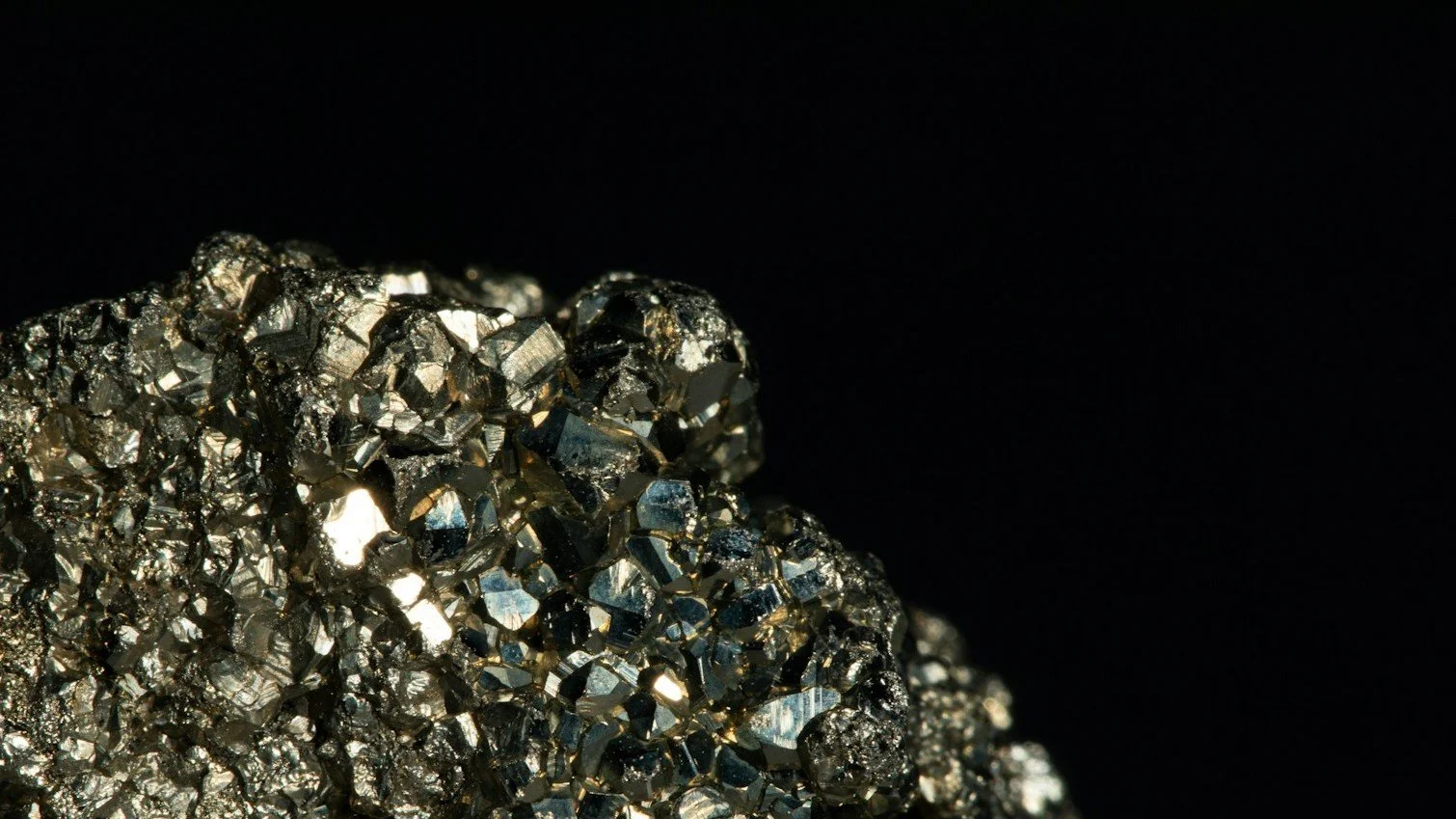
There is also a fragmented myth that at some point the very stones of the Earth became hostile to Ninurta, who was then forced to fight them, and on winning then doled out their fates, stating what each one will be used for. This could be why later Saturnian Greek & Roman myths, of the gods Saturn and Cronos, associate the planet with minerals and the wealth that comes from them, as well as eventually money, success, and legacy.
So we can see that Saturn is connected to many things that seem ancient and unchanging, like justice and the need for collective systems of order, our reliance on agriculture and material sustenance, the Earth itself and all the minerals as well as mysteries she contains within, and time or fate, ever turning eon after eon. But also we can see how this planet is connected to responsibility and the need to protect what is right while also putting those with ill-will in their place for the collective good. Yet this planet does this without needing to be flashy or receive praise, but rather as a result of disciplined action and honest care.
the Planet
And now, what about the actual planet Saturn?
Saturn is the second largest planet, only behind Jupiter (cousin rivalry still at play), yet has the most moons of any planet in our social systems, coming in at 274 (big Daddy energy, no?), one of which is named Titan and is the only moon in our system that has a substantial atmosphere.
Saturn is known in the modern era by its rings, though they were not observable until telescopic observation in the 1600s. Yet due to the inclinations of the rings throughout Saturn’s orbit, which catch the Sun’s light, there are times when the planet appears brighter in the sky than at others, and possibly is why the planet was called “the star of Helios (the Sun)” in Roman times or was associated with the Sun at all. Saturn does have the longest orbit of any easily visible planet, coming in at roughly 29.5 years per astrological cycle.
To earlier civilizations Saturn would have appeared as a bit of an anomaly at times, especially with something unknown causing it to occasional shine. It’s no wonder then that this planet became a symbol of mysterious karmic patterns and divine cycles.
Digging Deeper
So now the age old question about Saturn: is he friend or foe? I would actually argue neither, but let me explain through a few other associations.
Let’s review one more mythological connection to Saturn energy, Kali Maa, the dark goddess of Hindu belief. She is the goddess of transformation and retribution, both compassionate and deadly, and is depicted as a mother, protector, and karmic liberator, but also as one who wields darkness to bring the light.
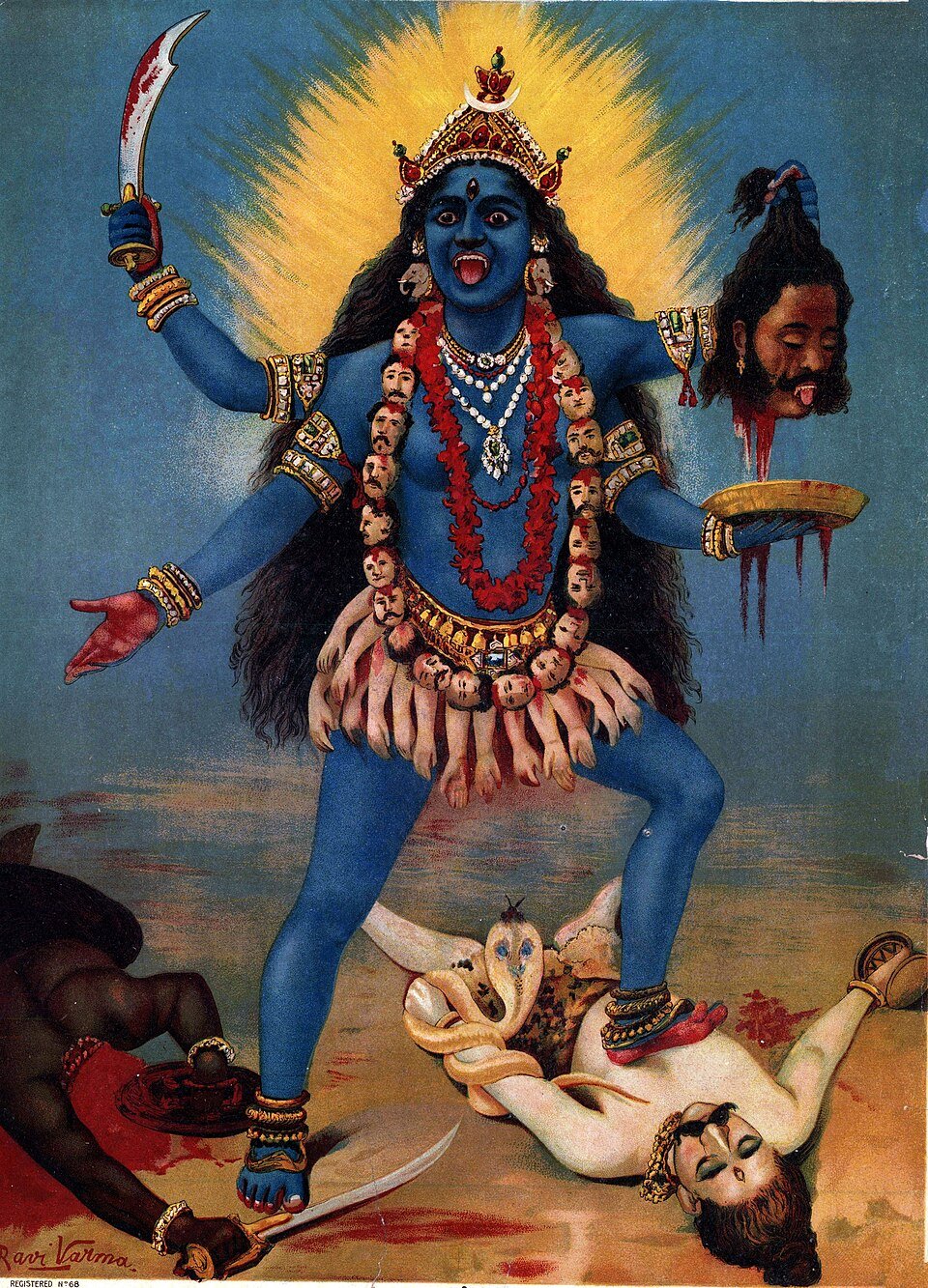
With Kali Maa, the pain she inflicts is never malicious in nature, it is simply a form of “tough love” to get one to grow or to right a wrong. She is seen not as a villain in their pantheon but as an integral and necessary aspect of the one goddess Shakti, thus showing her harsh role as an important one in a more holistic view of life and energetic harmony.
We can see within this that Saturn energy is not intentionally cruel or harsh, but rather simply the one who balances the scales, which could be retribution or liberation depending on what we are due, but it is all out of a desire for wholeness, harmony, and even love.
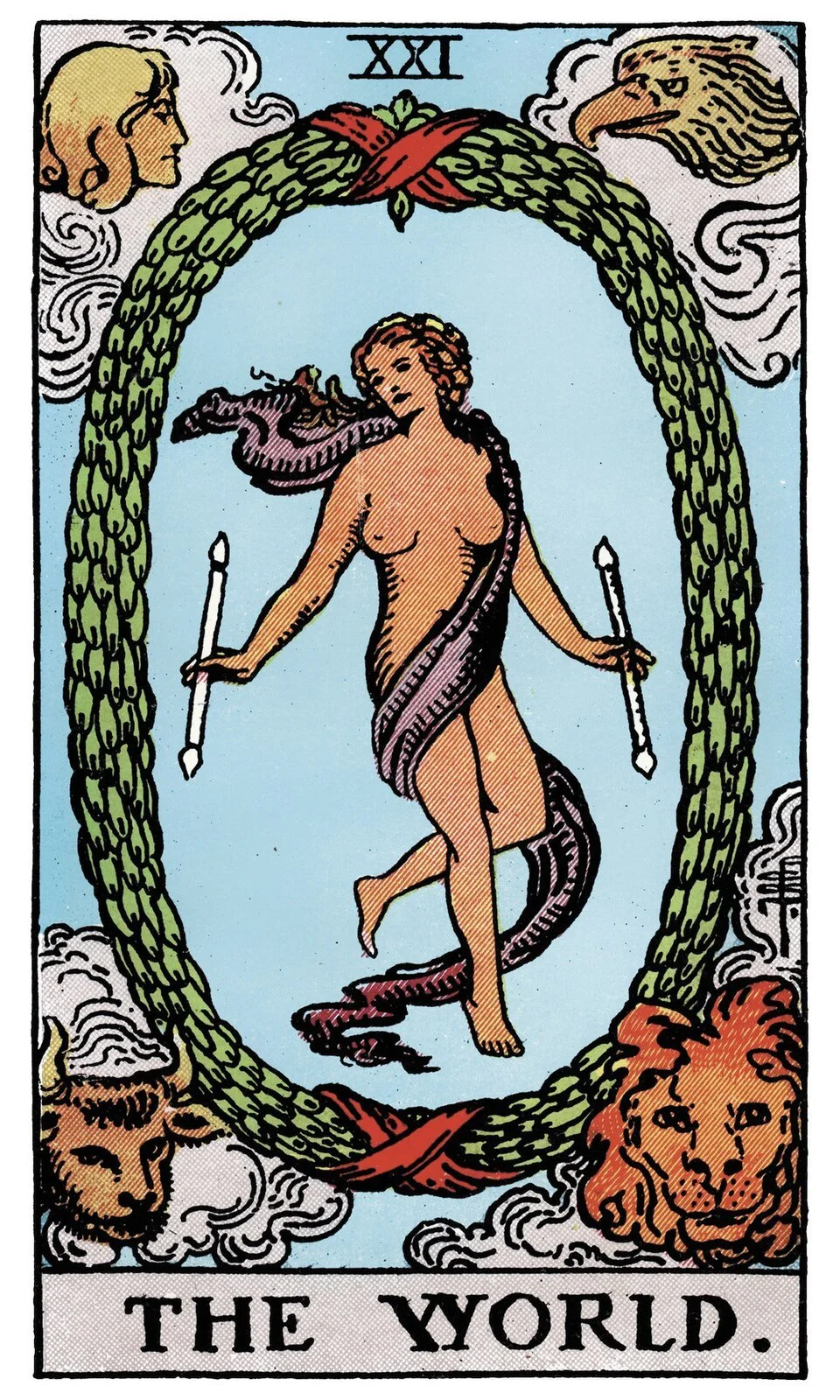
In the Tarot, Saturn is associated with The World card, the final card of the Major Arcana. This is a card depicting completion of the spiritual path where one has achieved the True Self. Although often obfuscated by a piece of material, the esoteric understanding of this card is that it depicts a hermaphrodite, one who is both biologically male and female simultaneously. This is meant to show that the True Self is beyond our imposed boundaries of this or that, right or wrong, yin or yang, but instead is the totality of all that we are and can be, the human and transcendent being fully blended.
When this card appears within a reading it’s often a sign that we are on our highest path, nearing a moment of cycle completion, and all is coming into aligned harmony.
So too with Saturn, its presence brings about an alchemical process of integrating our various internal splits - light and dark, conscious and unconscious, masculine and feminine, past and future - forcing us to confront all aspects of the self in order to achieve our highest and best state of being. If that requires some shadow work or heavy emotional lifting, the planet says “so be it.”
And finally to reference the well-known astrology heavyweight Liz Greene in her book “Saturn: A New Look at an Old Devil,” she compares Saturn to the Beast of fairy tales, who is harsh, ugly, and fear inducing, yet when loved for who he is becomes the Handsome Prince.
“In esoteric teaching, Saturn is the planet of discipleship, and a disciple is simply someone who is learning. He is not malefic; he is not a negative influence and is only inimical to those who cannot understand the educational value of pain. His path is not that of the martyr or the disciplinarian but instead contains the seed of joy. His lineage is ancient and impeccable, and his associations in the world of myth, religion, folklore, and fairytale are innumerable and varied, yet always coloured by the idea that instead of running away from the devil, if one goes up and kisses him on the lips, he becomes the sun.”
So we can see that Saturn is neither to be feared, but also is not one to be approached lightly, but with deep intention and understanding. In the same way we may begin to see that pain, setbacks, hardship and challenges are not always things to fear or consider ourselves victims of, but rather that they too are simply opportunities for transformation, integration, and possibly even new levels of joy and growth.
What This Means for You
In the Natal Chart
If looking to your natal chart, seeing whatever sign and house your Saturn is within will show you the place that holds your opportunity for challenge and growth, and ultimately the conditions needed for your own transformation into your True Self to best be achieved. What might your natal Saturn be revealing are the areas of life that hold potential for your own painful alchemical process?
Explore your fears or setbacks, and subsequent opportunities for healing, within these areas of life:
Aries/1st House: individuality, personal sovereignty, instincts & action, the physical body
Taurus/2nd House: self-cultivation & beauty, material possessions, stability, physical labor
Gemini/3rd House: personal psychology, information & knowledge, communication, open mindedness
Cancer/4th House: emotional awareness, familial bonds, safety, unconscious patterning
Leo/5th House: creative freedom, self-trust, being perceived, communal responsibility
Virgo/6th House: personal health, harmony with nature, beliefs & devotion, community wellness
Libra/7th House: personal relationships, morality, internal harmony, collective norms & values
Scorpio/8th House: mortality, the collective unconscious, personal desires, anything taboo
Sagittarius/9th House: higher learning or collective wisdom, cultural appreciation, energetic/instinctual mastery, societal betterment
Capricorn/10th House: hierarchy & leadership, personal & collective success, legacy, material mastery
Aquarius/11th House: intellectual mastery, heretical beliefs, collective liberation & unity, service
Pisces/12th House: spirituality, emotional mastery, loss of self/self-transcendence, universal oneness
Saturn Returns
Many in the astrological community bemoan a Saturn Return, first happening roughly between 27-32 years old, when Saturn returns to the same natal degree as in the birth chart. Why? Because it often means a reckoning of sorts, as what isn’t aligned falls away and our shortcomings or bad habits are made clear. If one can move through this time with the mentality of a rose bush being pruned, then the releasing and transforming of this time can blossom in the years to come. But if one resists the change and doubles down on outdated systems of being, then so too will one reap what one sows in a most likely misaligned life.
This cycle repeats again around the years 56–60 and 86–90, and one can see how each return marks the end and beginning of a new cycle: first (27-32) the end of youth and the beginning of adulthood, then (56-60) the end of adulthood into elderhood, and then once again (86-90), if we are so lucky, from elderhood to facing life’s final stage of transition, death. And so we can see why Saturn represents cycles, karma, time and destiny, and even death, as its orbit reappears at each major stage of transition throughout the human life span.
If you’ve already moved through any of these Saturnal cycles, look back and ask yourself:
What was hard? What was lost?
What was learned? What was gained?
Current Transits
Collectively we are currently on the cusp of a Saturnian shift, as it moves from Pisces into Aries in mid February, which many astrologers are predicting will bring up the more aggressively determined and fiercely proactive side of Saturn, resulting in potentially big and sweeping collective changes now until it leaves the sign in 2028.
But Aries marks the start of a whole new nearly 30 year cycle, as Saturn begins its journey through all the signs once again. How these cycles will actually play out is for us to determine, but I would encourage us to see the gift in this transit and the broader energy of a new beginning.
For now though, Saturn in Aries asks us:
What does true equality of sovereign individuals look like within our communities and within our global politics?
How can we make self-determination easier, more accessible, and safer?
How are our physical bodies being harmed by outdated collective choices?
Where do we need to act NOW and how do we mobilize action and resources to the most pressing issues of our lives and society?
Final Thoughts
Many of us know the phrase “nothing worth having comes easy,” but are we actually comfortable with this concept? Us in the West have been brought up in a culture that celebrates and rewards instant gratification, quick fixes, get-rich-quick schemes, and disposable trends. But that is not how anything long lasting or sustainable is built. It’s time we focus our attention on the long road of justice and truth, as many are becoming more and more aware is the only one worth taking.
Yet Saturn doesn’t have to be the cruel headmaster striking our knuckles to reprimand our failures or to get us into line. Rather he reminds us to stop following the “shoulds” or praising discipline for discipline's sake, and instead become devotees of deeper truths.
If I am devoted to my craft or work in the world, then I must also be accepting of the restrictions on my time and energy that such an endeavor will naturally require.
If I am devoted to healthy families and communities, then I must also be devoted to the vulnerability of reciprocity, reparations, and conflict resolution that naturally arise when many humans of many different walks of life attempt to do meaningful life together.
If I am devoted to the betterment of the planet and the people within it, then all I do should be towards that aim, from what I eat to what I wear to how I move through my day.
Saturn will not tolerate performative duty or selective action. Saturn asks for our True Self to fully show up, warts and all, so we can begin to act from a place of internal fortitude that will not be easily swayed by the chaos raging around us. And if you feel like that’s not you just yet, that’s okay, because Saturn has all the patience in the world. Start now though, commit to what you find to be true, and allow that truth to filter into all aspects of your life and being.
Although this idea that “the arc of the moral universe is long, but it bends toward justice” has been referenced by many, Martin Luther King Jr. being possibly the most prominent, it first appears in the words of Unitarian abolitionist pastor, Theodore Parker, written in 1853:
“Look at the facts of the world. You see a continual and progressive triumph of the right. I do not pretend to understand the moral universe, the arc is a long one, my eye reaches but little ways. I cannot calculate the curve and complete the figure by the experience of sight; I can divine it by conscience. But from what I see I am sure it bends towards justice.
Things refuse to be mismanaged long. Jefferson trembled when he thought of slavery and remembered that God is just. Ere long all America will tremble.”
May we be the ones so devoted to a bright and hopeful and holistic future, that no other option becomes possible. May we be the ones who turn to face the devil of this moment, who see and hold the pain fully and honestly, so that it too can be transformed into the beautiful world we know is possible.
And may America and all the global institutions built on the harm of others continue to tremble. We are the midwives of this great reckoning and reunification, have faith in that please.
And to help channel this energy into our lives, I’ve made a playlist all around Saturnian themes, which you can listen to on Spotify or YouTube Music.
Wishing you all a lovely rest of Saturn season.
To your becoming whole,
l.
